
Counterintelligence, Insider Threat Program, and Compliance FAQ
Answers to common questions about insider threat programs, counterintelligence, SEAD-3 reporting, NISPOM compliance, 351X software, and IXN Solutions’ training and advisory services.
- Insider Threat & Counterintelligence
- SEAD-3 Compliance
- NISPOM Compliance
- 351X Software
- Training & Services
- Implementation & Adoption
Insider Threat & Counterintelligence
What is an insider threat program?
An insider threat program is a structured capability designed to identify, assess, and respond to risks from individuals with authorized access who may intentionally or unintentionally harm an organization.
What is counterintelligence in a business context?
Counterintelligence in a business context helps organizations identify, understand, and reduce threats from foreign intelligence entities, competitors, insiders, and other adversarial actors targeting people, data, intellectual property, or operations.
What is the difference between insider threat and counterintelligence?
Insider threat programs focus on risks from trusted insiders, while counterintelligence also considers external adversaries, foreign intelligence targeting, influence, elicitation, and espionage risks.
Why do companies need an insider threat program?
Organizations need insider threat programs to protect sensitive data, comply with regulatory requirements, and prevent financial, reputational, and operational damage.
What are common insider threat indicators?
Common indicators include unusual access patterns, foreign contacts, unexplained wealth, policy violations, and attempts to bypass security controls.
SEAD-3 Compliance
What is SEAD-3?
SEAD-3 (Security Executive Agent Directive 3) establishes reporting requirements for cleared personnel, including foreign contacts, travel, financial anomalies, and security concerns.
Who must comply with SEAD-3?
Cleared personnel and organizations operating under the National Industrial Security Program (NISP) must comply with SEAD-3 reporting requirements.
What must be reported under SEAD-3?
Reportable items include:
- Foreign contacts and relationships
- Foreign travel
- Suspicious activities
- Financial issues
- Security violations
How do companies manage SEAD-3 reporting?
Organizations manage SEAD-3 reporting through structured workflows, training, and increasingly through software platforms that centralize submissions and tracking.
What is SEAD-3 compliance software?
SEAD-3 compliance software enables organizations to collect, track, and manage employee reporting requirements in a structured, audit-ready system.
NISPOM Compliance
What is NISPOM?
The National Industrial Security Program Operating Manual (NISPOM), codified at 32 CFR Part 117, establishes requirements for protecting classified information within cleared industry.
What does an FSO do under NISPOM?
A Facility Security Officer (FSO) is responsible for implementing and managing the organization’s security program, including personnel security, training, reporting, and compliance.
How do organizations stay compliant with NISPOM?
Organizations maintain compliance through documented processes, training, reporting systems, and preparation for DCSA inspections.
What is NISPOM compliance software?
NISPOM compliance software helps FSOs manage personnel, training, reporting, and audit readiness in a centralized platform.
How does NISPOM relate to SEAD-3?
SEAD-3 reporting requirements are a key component of NISPOM insider threat program requirements, and both must be managed together for full compliance.
351X Software
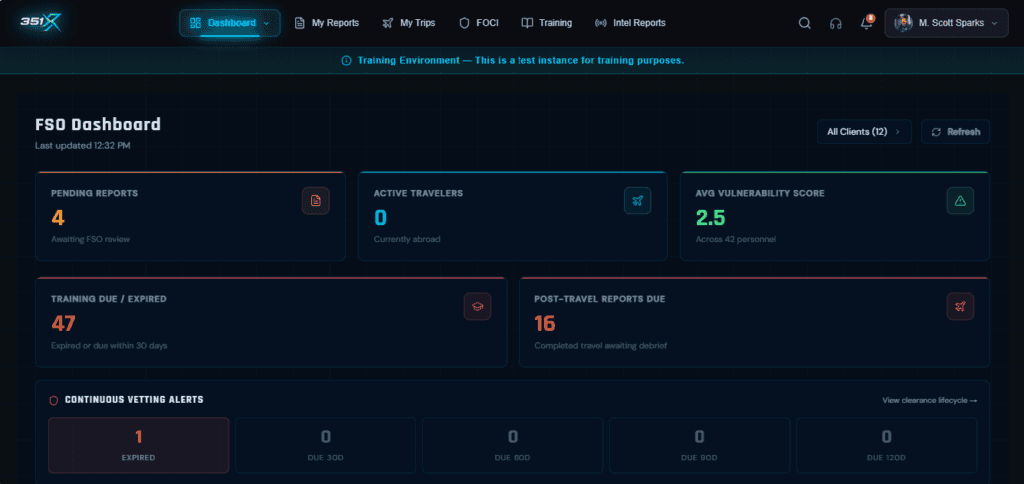
What is 351X?
351X is a counterintelligence-driven SaaS platform designed to manage insider threat programs, SEAD-3 reporting, and NISPOM compliance.
What does 351X do?
351X enables organizations to:
- Collect employee reporting
- Track compliance requirements
- Manage insider threat workflows
- Maintain audit-ready records
Who is 351X designed for?
351X is built for FSOs, CISOs, security teams, and organizations in the defense industrial base and enterprise environments.
Is 351X compliant with government standards?
351X is designed to support compliance with SEAD-3 and NISPOM requirements and is aligned with industry security best practices.
Does 351X replace insider threat programs?
No. 351X enables and enhances insider threat programs by providing structure, automation, and visibility.
Services & Training
What counterintelligence services does IXN Solutions provide?
IXN Solutions provides:
- Counterintelligence training (T2P)
- Virtual Insider Threat programs (vINT)
- Risk assessments and advisory services
What is T2P (Theory to Practice)?
T2P is a training program that translates counterintelligence concepts into practical, real-world application for organizations.
What is a virtual insider threat program (vINT)?
vINT is a fractional service that allows organizations to outsource insider threat program development and management.
Who needs counterintelligence training?
Organizations handling sensitive data, intellectual property, or operating in regulated environments benefit from counterintelligence training.
How often should insider threat training be conducted?
Training should be conducted at onboarding and annually, with ongoing awareness reinforcement.
Implementation & Adoption
How long does it take to implement an insider threat program?
Implementation timelines vary but can range from weeks to months depending on organizational maturity and resources.
How do you get employees to participate in reporting?
Organizations increase participation by simplifying reporting, building trust, and reinforcing a culture of security awareness.
What are common challenges in insider threat programs?
Common challenges include low reporting participation, fragmented systems, lack of visibility, and compliance burden.
How can organizations improve insider threat program effectiveness?
Effectiveness improves through training, centralized systems, leadership support, and integration with broader security programs.
How do you measure the effectiveness of an insider threat program?
Organizations measure the effectiveness of an insider threat program by evaluating both activity and outcomes. Common metrics include reporting rates, timeliness of report submission, number of validated incidents, resolution time, and participation in training. Effective programs also assess qualitative factors such as employee awareness, leadership engagement, and overall culture of reporting. Over time, a mature program should show increased visibility, improved response efficiency, and more informed, defensible security decisions.
Last Updated: 3 May 2026