
SEAD-3 Compliance Software & Reporting Requirements
SEAD-3 compliance software can help FSOs and insider threat programs streamline employee reporting, reduce manual processes, and maintain visibility across reportable activities. IXN’s 351X platform centralizes SEAD-3 reporting requirements – including foreign travel, foreign contacts, life events, and suspicious incidents – in a purpose-built workflow for cleared organizations.
What Is SEAD-3?
Security Executive Agent Directive 3 (SEAD-3), Reporting Requirements for Personnel with Access to Classified Information or Who Hold a Sensitive Position, establishes reporting requirements for covered individuals and responsibilities for organizations responsible for managing those reporting obligations.
For cleared contractors, SEAD-3 reporting requirements work in conjunction with applicable National Industrial Security Program Operating Manual (NISPOM) requirements to help identify circumstances, activities, and behaviors that may affect an individual’s continued eligibility for access to classified information or present a potential security concern.
Effective compliance requires more than simply informing employees of their responsibilities. Organizations need reliable processes to collect reports, route them to appropriate security personnel, document actions taken, and maintain records that support security and insider threat program responsibilities.
What Are the SEAD-3 Reporting Requirements?
SEAD-3 establishes reporting requirements covering a range of activities and circumstances that may have security relevance. Depending on the individual’s access, position, and circumstances, reportable information may include:
- Foreign travel
- Foreign contacts and continuing associations
- Foreign activities and interests
- Changes in personal status and certain life events
- Arrests and other law enforcement involvement
- Financial considerations or anomalies
- Adverse information
- Suspicious contacts, approaches, or attempted exploitation
- Other circumstances that may raise a security concern
Organizations must also ensure that reports reach the appropriate security personnel and that potentially significant information is evaluated and handled in accordance with applicable security requirements.
SEAD-3 Reporting Checklist for Cleared Organizations
An effective SEAD-3 compliance process should enable an organization to:
- Educate covered personnel on their reporting responsibilities
- Provide an accessible method for submitting required reports
- Capture foreign travel and foreign contact information
- Collect relevant life event and status-change reporting
- Document suspicious contacts and potential security incidents
- Route reports to FSOs or other designated security personnel
- Track reports requiring review or follow-up
- Maintain appropriate records and audit trails
- Identify information that may require escalation or additional action
- Integrate personnel reporting into the organization’s broader insider threat program
The specific reporting and handling requirements applicable to an individual or organization may vary based on access, position, contractual requirements, and governing security requirements.
| Reporting Area | Examples | 351X Support |
| Foreign Travel | Planned/foreign travel reporting | Digital submission and tracking |
| Foreign Contacts | Continuing associations with foreign nationals | Structured contact reporting |
| Life Events | Marriage, divorce, changes in status, etc. | Centralized reporting workflow |
| Suspicious Contacts | Possible targeting or elicitation | Incident reporting and escalation |
| Adverse Information | Relevant security concerns | Documentation and case tracking |
How SEAD-3 Relates to NISPOM
For cleared defense contractors participating in the National Industrial Security Program, SEAD-3 personnel reporting requirements are implemented alongside applicable NISPOM requirements.
In practical terms, cleared employees need to understand what they are required to report, while FSOs and security personnel need processes for receiving, reviewing, documenting, and appropriately acting on that information.
This creates both an employee reporting requirement and an organizational workflow requirement. A compliant process should make reporting straightforward for personnel while giving security teams the visibility and documentation necessary to manage those reports effectively.
Why SEAD-3 Compliance Is Difficult
SEAD-3 compliance can become administratively burdensome when reporting depends on email, spreadsheets, PDFs, shared drives, or disconnected forms.
Manual processes can make it difficult to:
- Determine whether required reports have been submitted
- Track foreign travel and foreign contacts consistently
- Identify reports awaiting FSO review
- Maintain complete and accessible records
- Document follow-up and resolution
- Identify patterns across multiple reports or personnel
- Provide leadership with visibility into emerging insider risk concerns
For organizations managing a growing cleared workforce, these challenges increase as reporting volume and program complexity grow.
How SEAD-3 Compliance Software Helps
SEAD-3 compliance software provides a centralized environment for employees and security personnel to manage reporting requirements.
Rather than relying on disconnected forms and manual tracking, organizations can establish structured workflows for submitting, reviewing, documenting, and managing reportable activities.
A purpose-built platform can help organizations:
- Standardize employee reporting
- Reduce administrative burden on FSOs
- Improve reporting consistency
- Track outstanding security actions
- Maintain complete audit trails
- Improve visibility across insider threat activities
- Connect individual reports to broader insider risk indicators
351X: Purpose-Built SEAD-3 Compliance Software
IXN’s 351X platform helps cleared organizations manage SEAD-3 reporting and insider threat program requirements through a centralized, purpose-built environment.
351X provides employees with straightforward reporting workflows while giving FSOs and security personnel the tools needed to review reports, manage follow-up, maintain documentation, and develop greater visibility across the organization.
Foreign Travel Reporting
Employees can submit foreign travel information through structured workflows, allowing security personnel to review planned travel and maintain centralized records of foreign travel activity.
Foreign Contact Reporting
351X provides a structured method for reporting and documenting foreign contacts, helping security teams maintain visibility into continuing foreign associations and identify information requiring additional review.
Life Event Reporting
Personnel can report relevant changes in circumstances and life events through standardized workflows, reducing reliance on informal email notifications or disconnected forms.
Suspicious Incident Reporting
Employees can report suspicious contacts, approaches, or other security-relevant incidents directly through the platform, providing security personnel with a centralized record for review and follow-up.
Centralized FSO Dashboard
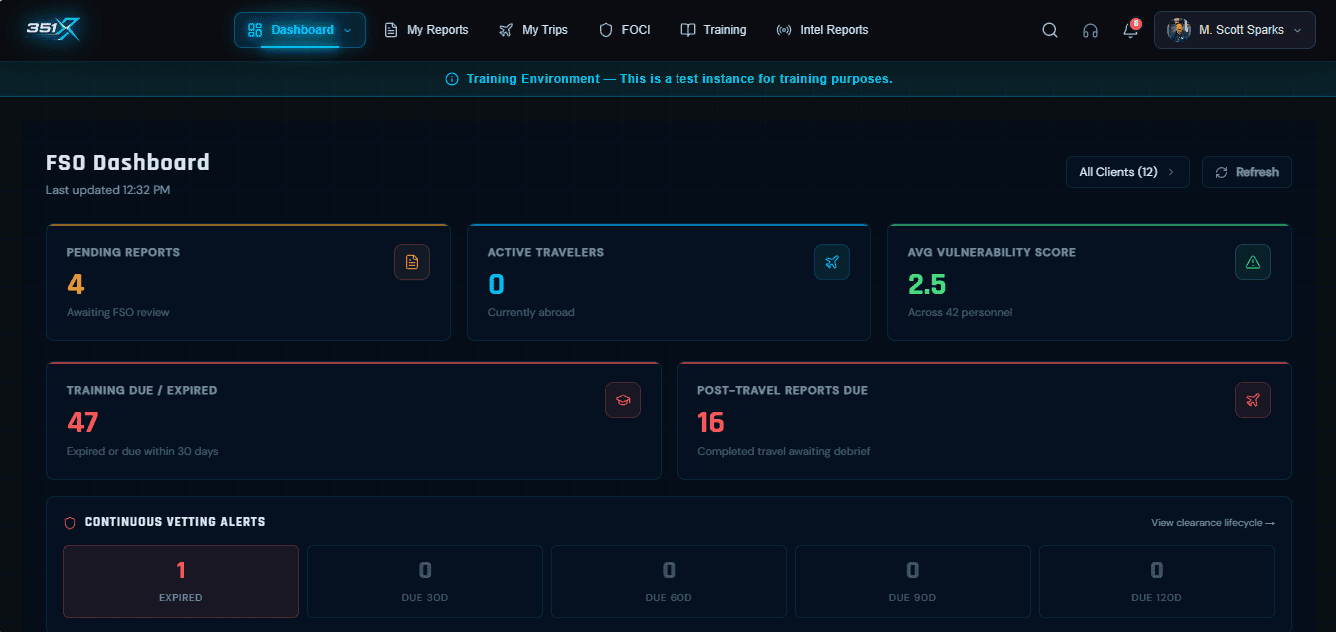
Security administrators can review submitted reports, monitor pending actions, and maintain visibility across reporting activity from a centralized dashboard.
Insider Risk Visibility
351X goes beyond simply collecting forms. Reporting information can contribute to a broader understanding of potential insider risk, helping security teams identify patterns and prioritize information requiring attention.
Built for FSOs and Insider Threat Programs
351X was developed specifically for organizations managing personnel security, counterintelligence, and insider threat responsibilities.
Unlike generic form builders or workflow tools, the platform is designed around the reporting and security challenges faced by cleared organizations. IXN brings operational experience in counterintelligence, insider threat, industrial security, and support to U.S. government and defense organizations to the development of the platform.
Strengthen Your SEAD-3 Compliance Posture
Move beyond spreadsheets and fragmented reporting. Implement a structured, counterintelligence-driven approach to insider threat program management.
Last Updated: 17 August 2026