

INSIDER RISK & PERSONNEL SECURITY
What is an Insider Threat Program?
Build an insider threat program that detects, deters, and manages insider risk before it becomes a security incident.
Organizations that handle classified information, intellectual property, sensitive research, or critical infrastructure face increasing risks from trusted insiders. An effective Insider Threat Program combines governance, reporting, awareness, investigations, and technology to identify risk early while protecting employees and organizational assets.
What Is an Insider Threat Program?
An Insider Threat Program is a structured organizational framework designed to identify, assess, and mitigate risks posed by trusted individuals who have authorized access to an organization’s people, information, facilities, systems, or intellectual property.
Contrary to popular belief, insider threats are not limited to employees who intentionally steal information or commit acts of espionage. Insider risk also includes negligent employees who inadvertently expose sensitive information, compromised insiders who are coerced or exploited by foreign intelligence services or criminal organizations, and trusted individuals whose personal circumstances or behaviors increase organizational risk.
An effective Insider Threat Program combines governance, employee reporting, security awareness, behavioral indicators, investigations, technology, and executive oversight to identify potential concerns before they develop into security incidents. These programs help organizations protect classified information, proprietary data, critical infrastructure, and sensitive research while fostering a culture of security and accountability.
The goal is not to monitor employees. It is to identify behaviors that increase organizational risk before damage occurs.
Core Components of an Insider Threat Program
✓ Governance
✓ Employee Reporting
✓ Insider Risk Assessments
✓ Awareness & Training
✓ Investigations
✓ Executive Oversight
Benefits of a Mature Insider Threat Program
✓ Detect risk earlier
✓ Meet regulatory requirements
✓ Protect IP and classified information
✓ Reduce insider incidents
✓ Improve reporting culture
✓ Strengthen organizational resilience
Why Organizations Need Insider Threat Programs
Today’s organizations face a broader range of insider risks than ever before. While espionage and the theft of classified information remain significant concerns for government and defense contractors, many organizations are equally vulnerable to fraud, sabotage, workplace violence, intellectual property theft, and the accidental disclosure of sensitive information.
Modern insider threats are often driven by financial stress, workplace grievances, foreign intelligence targeting, cyber compromise, or simple human error. At the same time, remote work, cloud collaboration, AI-enabled tools, and increasingly sophisticated social engineering have expanded opportunities for trusted individuals to unintentionally—or deliberately—place organizational assets at risk. Recent threat reporting also shows that organizations continue to experience a rise in insider-related incidents, with negligence remaining one of the leading causes of data loss while state-sponsored actors increasingly target trusted employees through recruitment, coercion, and credential theft.
An effective Insider Threat Program helps organizations identify behavioral indicators, encourage responsible reporting, investigate potential concerns, and intervene before incidents escalate into security breaches, operational disruption, financial loss, or reputational damage. By combining governance, employee awareness, reporting processes, and technology, organizations can better protect their people, intellectual property, classified information, and mission-critical operations.
Common Insider Threat Indicators
Behavioral
Sudden Financial Stress
Policy Violations
Disgruntlement
Foreign Influence
Digital
Large Downloads
USB Use
Cloud Uploads
Privilege Escalation
Physical
Unauthorized Photography
Access After Hours
Badge Misuse
Restricted Area Access
Types of Insider Threats
Malicious
Intentional Theft
Sabotage
Espionage
Negligent
Mistakes
Phishing
Poor Cyber Hygiene
Compromised
Coercion
Blackmail
Foreign Recruitment
Third-party
Contractors
Vendors
Temporary Staff
Insider Threat Program Maturity
Level 1
Reactive
Security incidents are handled individually with little formal governance, limited documentation, and no dedicated insider threat program.
Level 2
Foundational
Basic policies, security awareness training, and reporting procedures exist, but implementation is inconsistent and largely compliance-driven.
Level 3
Operational
A formal Insider Threat Program is established with defined governance, employee reporting, investigations, and documented response procedures.
Level 4
Integrated
Insider risk is actively managed through cross-functional collaboration between Security, HR, Legal, IT, and leadership, supported by data-driven assessments and technology.
Level 5
Optimized
Insider risk management is fully integrated into organizational operations with continuous monitoring, proactive risk identification, executive oversight, and ongoing process improvement.
Where Does Your Organization Stand?
Most organizations fall between Level 2 and Level 3, having implemented basic compliance requirements but lacking a fully integrated, proactive Insider Threat Program. A CI Exposure Assessment™ provides an independent evaluation of your organization’s current maturity, identifies capability gaps, and delivers practical recommendations for advancing your program.
Common Compliance Drivers
NISPOM
Requires Insider Threat Programs
The National Industrial Security Program Operating Manual (NISPOM) requires cleared contractors to establish and maintain a formal Insider Threat Program capable of detecting, reporting, and mitigating insider risk.
SEAD-3
Personnel Security Reporting
SEAD-3 establishes continuous personnel security reporting requirements, requiring employees to report foreign contacts, foreign travel, financial concerns, criminal conduct, and other reportable behaviors that may affect eligibility for access to classified information.
DCSA
Security Reviews & Assessments
The Defense Counterintelligence and Security Agency (DCSA) evaluates Insider Threat Programs during security reviews, assessing governance, training, reporting processes, investigations, and overall program effectiveness.
Why These Requirements Matter
NISPOM establishes the requirement, SEAD-3 defines many of the reportable behaviors, and DCSA evaluates how effectively organizations implement their Insider Threat Programs. Together, they form the foundation of insider risk management across the Defense Industrial Base.
How IXN Solutions Helps
Solutions That Support Every Stage of Program Maturity
Whether you’re evaluating your current posture, preparing for a DCSA Security Review, or building a mature Insider Threat Program, IXN Solutions provides services and technology that meet organizations where they are, and help them move forward.
CI Exposure Snapshot™
Know Where You Stand
Receive a rapid, questionnaire-based maturity score that identifies strengths, gaps, and immediate priorities for improving your insider threat program.
Ideal for organizations just getting started.
CI Exposure Assessment™
Validate Your Risk
Our counterintelligence professionals conduct an independent assessment, validate exposure drivers, perform external research, and deliver recommendations.
Best for organizations maturing their program.
Enterprise Engagement™
Build a Program
Partner with IXN to design, implement, and continuously improve an enterprise Insider Threat Program aligned with NISPOM, and organizational objectives.
Ideal for long-term program development.
351X™ Insider Risk SaaS
Manage Your Program
351X provides secure personnel security reporting, foreign travel management, suspicious activity reporting, and insider risk management workflows in one centralized platform.
Built for compliance and operational visibility.
Frequently Asked Questions About Insider Threat Programs
What is an Insider Threat Program?
An Insider Threat Program is a structured organizational capability designed to identify, assess, report, and mitigate risks posed by trusted individuals who have authorized access to facilities, information, or systems. The program addresses both intentional threats, such as espionage, theft, and sabotage, and unintentional risks caused by negligence, mistakes, or compromised personnel.
Who needs an Insider Threat Program?
Organizations that operate within the Defense Industrial Base (DIB), hold Facility Clearances (FCLs), or work with classified information are generally required to establish Insider Threat Programs under NISPOM. However, any organization responsible for protecting sensitive intellectual property, research, critical infrastructure, or proprietary information can benefit from implementing an Insider Threat Program.
Is an Insider Threat Program only for malicious employees?
No. Most insider incidents are not caused by malicious intent. Effective Insider Threat Programs address a broad range of risks, including accidental data disclosure, phishing victims, poor cybersecurity practices, workplace violence indicators, foreign influence, and compromised personnel. The goal is to identify concerning behaviors before they result in organizational harm.
What is the difference between an Insider Threat Program and an Insider Risk Program?
The terms are often used interchangeably, but they are not identical. Insider Threat Programs are typically compliance-driven and focus on security requirements established by NISPOM and DCSA. Insider Risk Programs generally take a broader enterprise approach that incorporates cybersecurity, HR, legal, physical security, fraud prevention, and organizational resilience. Many mature organizations integrate both concepts into a unified risk management program.
What regulations require Insider Threat Programs?
For cleared contractors, the primary requirements come from the National Industrial Security Program Operating Manual (NISPOM), which requires organizations to establish and maintain Insider Threat Programs. Additional reporting obligations are established through Security Executive Agent Directive 3 (SEAD-3), while the Defense Counterintelligence and Security Agency (DCSA) evaluates Insider Threat Programs during security reviews and inspections.
How do organizations identify insider threats?
Organizations identify insider threats by combining policy, employee reporting, security awareness training, investigations, cybersecurity monitoring, personnel security reporting, and risk assessments. Rather than relying on a single indicator, mature programs evaluate patterns of behavior across multiple risk areas while protecting employee privacy and civil liberties.
What are common indicators of insider risk?
Potential indicators include unexplained foreign contacts, unauthorized access to sensitive information, unusual downloading or printing of files, repeated security policy violations, financial distress, workplace conflicts, criminal activity, suspicious travel, attempts to bypass security controls, or significant behavioral changes. One indicator alone rarely confirms a threat, but multiple indicators may warrant additional review.
How can IXN Solutions help?
IXN Solutions helps organizations build, evaluate, and mature Insider Threat Programs through Counterintelligence Exposure Assessments™, policy development, security program design, executive advisory services, and the 351X™ platform for personnel security reporting and insider risk management. Whether your organization is starting from scratch or preparing for a DCSA review, IXN can help strengthen both compliance and operational effectiveness.
Build an Insider Threat Program
Whether you’re building your first Insider Threat Program or strengthening an existing one, IXN Solutions provides the assessments, consulting, training, and technology to help organizations identify human risk before it becomes a security incident.

351X – Insider Threat Program SaaS
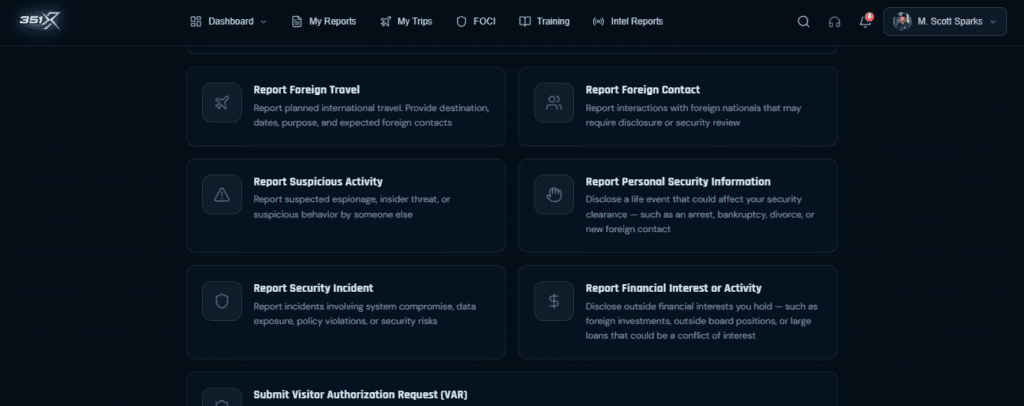
351X is a SOC 2 Type 2 attested, patent-pending SaaS platform built for FSOs, ISSMs, and Insider Threat Program Officials managing NISPOM and SEAD-3 compliance. It unifies employee reporting, CI-based risk scoring, foreign travel management, and suspicious activity tracking in a single secure workflow, purpose-built for cleared defense contractors.
About IXN Solutions
IXN Solutions provides training and counterintelligence-driven insider risk, personnel security, and operational security services for cleared industry, critical infrastructure, research, and enterprise organizations.
Learn more about:
- insider risk program support,
- SEAD-3 operational workflows,
- security assessments,
- and 351X insider risk management solutions.
Last Updated: 28 June 2026